JAVA开启异步线程的方式:
1.Thread类
2.Runnable接口
3.FutureTask类
演示类说明
1
2
3
4
5
6
7
8
9
10
11
12
13
14
15
16
17
18
19
20
21
22
23
24
25
26
27
28
29
30
31
32
33
34
35
36
37
38
39
40
41
42
43
44
45
46
47
48
49
50
51
52
53
| package per.guc.gucproject.test;
import lombok.extern.slf4j.Slf4j;
import java.util.concurrent.Callable;
import java.util.concurrent.FutureTask;
@Slf4j
public class Test01 {
public static void main(String[] args) {
Test01 test01 = new Test01();
test01.thread01();
test01.thread02();
test01.thread03();
}
public void thread01(){
new Thread("thread01"){
public void run(){
log.debug("创建线程方式1,启动啦。。。。");
}
}.start();
}
public void thread02(){
new Thread(new Runnable() {
@Override
public void run() {
log.debug("创建线程方式2,启动啦。。。。");
}
}, "thread02").start();
}
public void thread03(){
new Thread(new FutureTask<Integer>(new Callable<Integer>() {
@Override
public Integer call() throws Exception {
log.debug("创建线程方式3,启动啦。。。。");
return null;
}
}), "thread03").start();
}
}
|
运行结果:

线程的5种状态操作系统层面,线程的6种状态Java层面
1
2
3
4
5
6
7
8
9
10
11
12
13
| #操作系统层面
1.新建状态(NEW)
2.就绪状态(READ)
3.运行状态(RUNNING)
4.阻塞状态(BLOCKED)
5.死亡状态(TERMINATED)
#JAVA代码层面
1.NEW(新建状态)
2.RUNNABLE(运行状态)
3.BLOCKED(阻塞状态)
4.WAITING(无时等待状态)
5.TIMED_WAITING(有时等待状态)
6.TERMINATED(死亡状态)
|

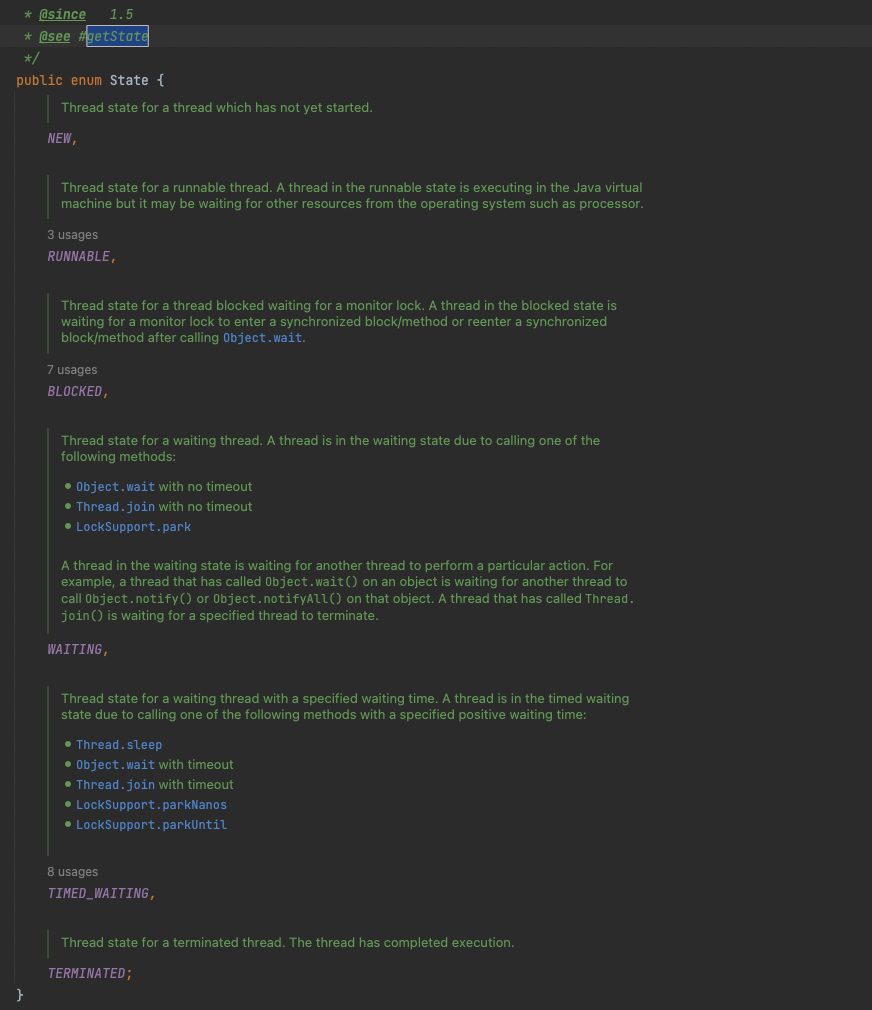
阻塞线程的方式和线程对应的状态.
演示类说明
1
2
3
4
5
6
7
8
9
10
11
12
13
14
15
16
17
18
19
20
21
22
23
24
25
26
27
28
29
30
31
32
33
34
35
36
37
38
39
40
41
42
43
44
45
46
47
48
49
50
51
52
53
54
55
56
57
58
59
60
61
62
63
64
65
66
67
68
69
70
71
72
73
74
75
76
77
78
79
80
81
82
83
84
85
86
87
88
89
90
91
92
93
94
95
| package per.guc.gucproject.test;
import lombok.extern.slf4j.Slf4j;
@Slf4j
public class Test02 {
public static void main(String[] args) {
Thread t1 = new Thread("thread01") {
@Override
public void run(){
log.debug("thread01 new ...");
}
};
Thread t2 = new Thread("thread02") {
@Override
public void run() {
log.debug("thread02 runnable ...");
while (true) {
}
}
};
t2.start();
Thread t3 = new Thread("thread03") {
@Override
public void run() {
synchronized (Test02.class) {
log.debug("thread03 time_waiting ...");
try {
Thread.sleep(3000);
} catch (InterruptedException e) {
throw new RuntimeException(e);
}
}
}
};
t3.start();
Thread t4 = new Thread("thread04") {
@Override
public void run() {
synchronized (Test02.class) {
log.debug("thread04 blocked ...");
try {
Thread.sleep(3000);
} catch (InterruptedException e) {
throw new RuntimeException(e);
}
}
}
};
t4.start();
Thread t5 = new Thread("thread05") {
@Override
public void run() {
log.debug("thread05 waiting ...");
try {
t3.join();
} catch (InterruptedException e) {
throw new RuntimeException(e);
}
}
};
t5.start();
Thread t6 = new Thread("thread06") {
@Override
public void run() {
log.debug("thread06 terminated ...");
}
};
t6.start();
try {
Thread.sleep(500);
} catch (InterruptedException e) {
throw new RuntimeException(e);
}
log.debug("t1 state, {}", t1.getState());
log.debug("t2 state, {}", t2.getState());
log.debug("t3 state, {}", t3.getState());
log.debug("t4 state, {}", t4.getState());
log.debug("t5 state, {}", t5.getState());
log.debug("t6 state, {}", t6.getState());
}
}
|
运行结果:

Thread.sleep()方法说明:
使当前执行的线程在指定的毫秒数内休眠(暂时停止执行),这取决于系统计时器和调度程序的精度和准确性,线程不会丢失任何监视器的所有权。
1
2
3
4
|
TimeUnit.MINUTES.sleep(1);
TimeUnit.SECONDS.sleep(1);
|
示例及测试结果:

